


Ube Powder Supplier | Dioscorea alata Specs & Applications
Ube - purple yam, Dioscorea alata - has moved from a Filipino dessert staple to a global ingredient. Ube lattes, ube cakes, ube ice cream and ube-flavoured snacks now sell in the US, EU, Middle East and Southeast Asia, and demand for a stable, food-grade ube powder has grown with it.
This guide covers what ube powder actually is, how it differs from purple sweet potato powder, the specifications importers should request, and how to source it without running into origin or labelling problems.
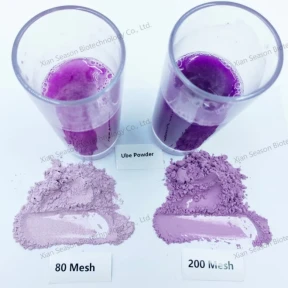
What Is Ube Powder
Ube powder is made from the tuber of Dioscorea alata, washed, peeled, cooked or dried, then milled and sieved into a fine powder. In powder form it is a true purple - the colour comes from cyanidin-based anthocyanins that are largely acylated with sinapic and ferulic acids (Moriya et al., 2015; Vishnu et al., 2023). Its flavour is deliberately mild and clean: lightly sweet and earthy, with a faint vanilla-like note rather than a strong tuber taste. The composition of the tuber, including its phytochemical and starch fractions, has been reviewed in detail elsewhere (Lebot et al., 2023).
Processing method matters as much as raw material: steam blanching and acidic soaking during flour production have been shown to reduce anthocyanin and polyphenol loss (Imanningsih et al., 2013).
Typical uses:
Natural colourant and flavour base for bakery - cakes, breads, cookies, mochi
Beverage ingredient - ube latte, smoothie, milk tea
Ice cream, gelato, cheesecake and halo-halo bases
Dry-form replacement for ube halaya where a consistent, long-shelf-life input is needed
Ube Powder vs Purple Sweet Potato Powder
This is the single most common confusion in the category, and the one that generates complaints after delivery. Both are purple powders; they are not interchangeable. Where purple sweet potato has been evaluated as a partial substitute in ube-based products, colour, aroma, flavour and overall acceptability all changed significantly (Borela, 2018).
Ube powder vs purple sweet potato powder
|
Item |
Ube (purple yam) |
Purple sweet potato |
|
Botanical name |
Dioscorea alata |
Ipomoea batatas |
|
Flavour |
Mild and clean, lightly sweet and earthy |
Strong, pronounced sweet-potato flavour |
|
Powder colour |
True purple |
Deep purple |
|
Colour after dissolving |
Lighter than purple sweet potato |
Deep and intense |
|
Texture |
Smooth |
Thick and viscous |
|
Mouthfeel |
Almost no fibrous feel |
Noticeably fibrous |
|
Relative price |
Higher |
Lower |
In practice the difference appears the moment the powder meets liquid: ube disperses to a lighter, softer purple and keeps the mix fluid, while purple sweet potato drives a much darker shade, thickens the mix noticeably and leaves a fibrous mouthfeel. A formula built on ube and a formula built on purple sweet potato therefore cannot be swapped one for one.
What Origin Really Means for Ube
The Philippines is the reference origin for ube - the crop, the flavour profile and the dessert culture all come from there, and Philippine-grown ube is what most buyers picture.
Ube is also cultivated and processed in China, India, Sri Lanka, the Caribbean, Hawaii and parts of Africa. Powder made from Dioscorea alata grown and processed in China is genuinely ube; aroma intensity still varies by cultivar, harvest and processing, so judge a lot on its sample rather than on origin alone.
Practical guidance for importers:
State the origin exactly as it is. Do not label China-origin material as Philippine origin, and do not promise a Philippine Certificate of Origin for goods that were not produced there.
If your market or your customer requires a specific origin, confirm it before the order, not after.
If flavour is the priority, request a pre-shipment sample from the actual production lot - origin alone does not guarantee the flavour profile.
Specifications to Request
Food-grade ube powder typical specification
|
Parameter |
Typical food-grade standard |
|
Product |
100% ube (Dioscorea alata) powder |
|
Appearance |
Fine, uniform powder, true purple |
|
Mesh |
200 mesh |
|
Moisture |
≤ 8% |
|
Purity |
No added colour, starch, sugar or preservative |
|
Heavy metals |
Pb, As, Cd, Hg within destination-market limits |
|
Microbiology |
Total plate count, yeast and mould, E. coli, Salmonella within destination-market limits |
|
Shelf life |
18–24 months in unopened packaging |
|
Packaging |
25 kg cardboard barrel with food-grade PE liner / 1–5 kg foil bag with self-sealing closure |
Ask every supplier for the lot COA, a written botanical identity statement, pesticide residue and heavy metal reports, and an allergen declaration. Ube itself is not a major allergen, but repacking facilities may handle other powders.
Applications and Dosage Starting Points
Starting inclusion rates by application
|
Application |
Typical inclusion |
|
Bread and cake |
3–8% of flour weight |
|
Cookies and mochi |
2–5% |
|
Ice cream / gelato base |
2–4% |
|
Beverage powder blend |
1–3% |
|
Natural colour substitution |
1–2%, adjust to target shade |
Start low. Ube powder is a colourant and flavour contributor, and excess inclusion can make crumb dense and slightly bitter. Because the colour comes from natural anthocyanins, expect mild fading at high bake temperatures or in high-pH systems - acylation improves pigment stability but does not make it heat-proof (Moriya et al., 2015), so this is normal behaviour for a clean-label purple, not a defect.
Sourcing and Logistics Notes
HS classification: milled dried tuber powder generally falls under heading 1106 (flour, meal and powder of roots and tubers of heading 0714). Confirm the exact national tariff line with your customs broker before booking.
Lead time: 7-10 days for standard grades after order confirmation and deposit; custom mesh and retail packing add time.
Loading: FCL and LCL from South China ports; retail-ready pouches available for private-label programmes.
Documents: commercial invoice, packing list, COA, health certificate, and origin documentation as applicable.
Samples: pre-shipment samples drawn from the production lot, so what you approve is what you receive.
FAQ
Is ube powder the same as purple sweet potato powder?
No. Ube is Dioscorea alata; purple sweet potato is Ipomoea batatas. Different flavour, different colour behaviour, different price.
Is the purple colour natural?
Yes, for pure ube powder the colour comes from the tuber's own anthocyanins. If a supplier offers a very bright, heat-stable purple at a low price, ask whether colour has been added.
Does ube powder contain gluten or dairy?
Pure ube powder contains neither. Check the repacking facility's allergen statement if you buy retail-packed material.
Can I get Philippine-origin material?
Origin availability changes by season and supplier. Confirm with your supplier in writing before you commit to a customer.
What MOQ should I expect?
Bulk programmes typically start at 25 kg for sampling and move to 500 kg–1 MT for commercial pricing; private-label retail packing usually MOQ:1kg.
Closing
Ube powder is a small, high-value category where documentation and botanical honesty matter more than price per kilo. If a supplier can show you the tuber, the lot COA and the exact origin in writing, the rest of the transaction is straightforward.
Request a specification sheet, lot COA and a 1 kg sample
WhatsApp: +86 13072926821
E-mail: sales03@xaseason.com
[1] Borela MB. Physico-chemical and functional properties, nutritional value and acceptability of purple yam (Dioscorea alata)-based jam (halaya) using purple sweet potato (Ipomoea batatas) and purple taro (Colocasia esculenta) as extenders. Journal of Nutrition & Food Sciences. 2018;8(2). doi:10.4172/2155-9600.1000678
[2] Imanningsih N, Muchtadi D, Wresdiyati T, Palupi NS, Komari. Acidic soaking and steam blanching retain anthocyanins and polyphenols in purple Dioscorea alata flour. Jurnal Teknologi dan Industri Pangan. 2013;24(2):121–128.
[3] Lebot V, Lawac F, Legendre L. The greater yam (Dioscorea alata L.): a review of its phytochemical content and potential for processed products and biofortification. Journal of Food Composition and Analysis. 2023;115:104987. DOI:10.1016/j.jfca.2022.104987
[4] Moriya C, Hosoya T, Agawa S, Sugiyama Y, Kozone I, Shin-ya K, Terahara N, Kumazawa S. New acylated anthocyanins from purple yam and their antioxidant activity. Bioscience, Biotechnology, and Biochemistry. 2015;79(9):1484–1492. DOI:10.1080/09168451.2015.1027652
[5] Vishnu VR, Jyothi AN, Sheela MN, Sreekumar J. Identification of anthocyanins in a purple yam (Dioscorea alata) accession and their in vitro antiproliferative activity. Journal of Plant Biochemistry and Biotechnology. 2023;32(3):467–477. DOI:10.1007/s13562-023-00828-2